customer story
Predictable premium patient growth — without ads
400% increase in monthly premium patients (MRR)


"We went from scattered marketing efforts to a clear system that consistently brings in the right patients.”
Jamie
Co-Founder, Rejuvenate
Rejuvenate had a strong medical offering but unclear market positioning, making it difficult for the right patients to find or understand them. With clearer messaging and a focused acquisition system, the practice achieved consistent, high-quality demand without increasing spend.
How a Medical Practice Built a Predictable Pipeline of 8+ Premium Patients per Month (100% Organic)
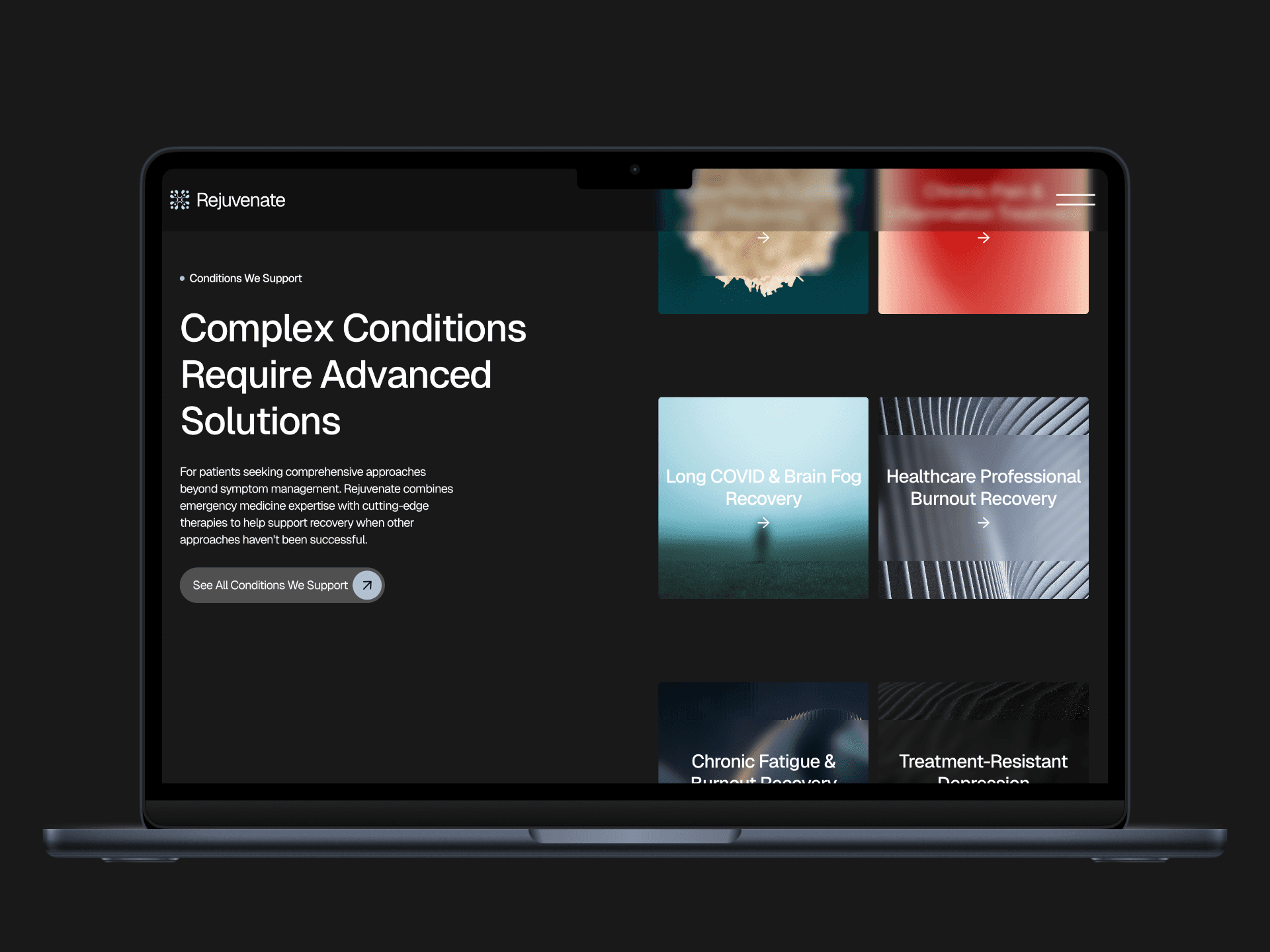
Industry: Medical Wellness / Functional Medicine
Stage at engagement: ~$90K annual revenue, two founders deeply involved in day-to-day operations
Engagement length: 6 months (July–December 2024)
Role: Fractional Marketing Leadership
THE OUTCOME
From unpredictable to systematic growth
1–2 inconsistent new patients/month → 8+ premium patients/month
100% organic acquisition (no ads)
2.75× LTV:CAC achieved within 5 months
Clear positioning separating physician-led care from commodity IV spas
A marketing system that continues operating without founder or consultant dependency
THE CONTEXT
Dr. James and Jamie ran a legitimate medical practice treating patients with treatment-resistant depression, chronic fatigue, and complex conditions where traditional medicine had failed.
Their protocols worked.
Their marketing didn’t.
The tension they felt:
“We’re helping patients who’ve exhausted every option — but we look identical to $99 IV bars and wellness spas. How do we grow without becoming one?”
They weren’t trying to scale a volume business.
They needed the right patients, consistently, without discounting or noise.
THE REAL PROBLEM (DIAGNOSIS)
This wasn’t an acquisition volume issue.
It was a positioning and clarity failure.
Their language (“NAD+ optimization,” “cellular regeneration”) mirrored the wellness industry
Their ideal patients searched for conditions, not treatments
Even when discovered, prospects couldn’t tell why this was medical care — not a spa experience
Before solving traffic or conversion, the core constraint was:
The business couldn’t clearly explain who it was for — or why it was different.
THE STRATEGIC DECISIONS
Decision 1: Fix positioning before scaling acquisition
We paused any attempt to “get more leads” and focused first on aligning the message with how real patients described their problems — not how the industry described treatments.
Decision 2: Compete at the condition level, not the category level
Instead of chasing “IV therapy” visibility, we targeted condition-specific searches (treatment-resistant depression, chronic fatigue, brain fog), where serious patients were actively seeking answers.
Decision 3: Build systems that reduce dependency
Every asset — content, email, reviews, analytics — was designed to function without ongoing oversight or founder heroics.
THE LEADERSHIP ROLE (WHAT I OWNED)
As fractional marketing leadership, my role was to:
Diagnose the real constraint holding growth back
Set strategic direction and sequencing
Define success metrics tied to patient quality and economics
Design and validate the acquisition system
Ensure everything could operate without me long-term
To validate strategy quickly and avoid handoff friction, I led the initial system build personally. Once proven, the systems were documented and transferred.
THE SYSTEM BUILT (OVERVIEW)
Positioning & Messaging
Reframed the practice around patient outcomes, not procedures
Clear distinction between physician-supervised care and wellness spas
Patient language replaced industry jargon
Acquisition Infrastructure
Condition-specific SEO architecture
Educational content answering real patient questions
Google Business and review generation system
Consultation fee introduced to improve lead quality and reduce no-shows
Nurture & Trust
Email education sequences explaining treatment philosophy
Founder-led content establishing medical authority
Analytics and dashboards for ongoing visibility
THE RESULTS
Patient acquisition
Before: 1–2 unpredictable patients/month
After: 8+ consistent premium patients/month
First organic bookings: Week 8
Patient quality
Shift from mixed “wellness tourists” to treatment-resistant patients
Willingness to invest in comprehensive care
Demographic expansion, including majority-male new patients by month six
Economics
Avg. monthly revenue from new patients: $7,554
Avg. LTV: $537 (3.31 visits × $280, 70% retention)
CAC: $195
LTV:CAC: 2.75×
Payback period: ~3 months
System durability
What continues working without ongoing involvement:
SEO content generating weekly bookings
Automated email nurture
Review system building social proof
Brand framework supporting multi-location expansion
THE PATTERN
This engagement followed a pattern I see repeatedly in sophisticated service businesses:
The product works
The customers exist
But unclear positioning makes them invisible — or indistinguishable
Growth didn’t require more marketing activity.
It required clarity first, then systematic acquisition.
WHY THIS WORKED
Diagnosis before execution: We solved the right problem first.
Sequencing over speed: Positioning came before volume.
Tight feedback loops: Strategy and implementation informed each other.
Systems thinking: Everything was designed to outlive individual effort.
WHAT THIS REQUIRED
From the founders
Willingness to change positioning
Ongoing insight into patient conversations
Trust to rebuild instead of patch
From leadership
Pattern recognition across regulated industries
Understanding of patient psychology and search behavior
Ability to translate strategy into systems, then remove dependency
The takeaway
This practice didn’t grow because of better tactics.
It grew because the business finally communicated what it actually was — to the people already searching for it — through a system designed to compound, not burn out.
Another Success Story